Rabu, 31 Oktober 2012
Great Rides: White Rim In A Day
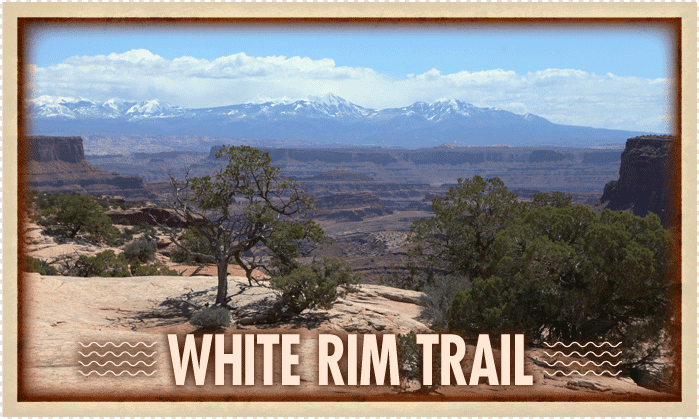
Since October’s the best month of playing outside I’ll end it with one more classic ride: The White Rim in a day. I did this a few weeks back with my friend Jeff (partner during last year’s 25-hr Frog Hollow race) and we caught perfect conditions for this stunning tour of the Canyonlands.
niebrugge images
The White Rim Trail is one of the most scenic roads in the world. Except for a few miles on the mesa you’re never not looking at postcard view. Unfortunately my phone broke en route, which is probably good for this post as I’ll use other, much better, photos, which also will provide reference links for anyone interested in more info on this classic adventure.
Doing it in a day is not requisite and, in fact, while a fairly-common tick for ultra geeks, is probably not the best way to do it. If I were going to pay a company to SAG for a long ride this might be the one. As Jeff said, “I can’t imagine there’s a better mountain bike tour in the world”. There are many Moab outfits happy to do this, like this one.
We, both ultra geeks, opted to skip the booze cruise option. If you found your way here it’s your lucky day as I’m going to provide some key beta. Jeff is a Moab local, spends an inordinate time exploring, and has thus learned many tricks for efficiency in the desert.
Look at the above topo. Now move the start to the bottom of the big finishing climb. We parked about a mile down this road, meaning that we had most of our climbing done before breakfast. We also stashed most of our water at the park entrance so we were able to climb without a ton of weight. Since it’s the least scenic part of the ride we also did it in the dark so that sunrise hit just as we were entering the good stuff. This piece of beta both gave us a nice warm-up during the chilly morning but also allowed us to finish on the flats along the river, instead of with a brutal climb. It was aesthetically perfect.
schaefer switchbacks: pat bonish
The riding on the White Rim, while technically easy, is challenging over the course of a day. Miles of slickrock beat you down and, by the end, my hands hurt more than anything else. At one point I made a comment on training for Paris-Roubaix and we spent a few miles mulling over the possibility of doing it on a road bike before dismissing it as nothing more than self-flagellation. You can ride the White Rim on anything but the more suspension you have the happier you’ll probably be.
a couple of the climbs are steep. good link for those looking for a more complete trip report
For us the ride was more style. Doing the climb in the dark also allowed us more time for sightseeing. We spent close to 2.5 hours poking around and still finished well before dark. We even got lucky and found this.
Jeff is the most interesting man in the desert, surely. He knows everything about the canyonlands and its history. Not only can he suffer but he’s also an excellent climber and has spent the last few decades on the trail of the Anasazi and Fremont. He’s is constantly filling in the authorities on locations of new archeological sites, which means I had a first rate historical tour of the White Rim and everything you can see from it. This, I suppose, is another reason why you might want to do this one guided, even if you opt to do it in a day.
Senin, 29 Oktober 2012
Can You Taper And Gain Fitness Simultaneously?
ClimbTech Removable Bolts for Rock Climbing from ClimbTech on Vimeo.
I did a birthday challenge test run this weekend. It was, unfortunately, harder than expected. Now I need to start tapering for a performance peak but I still lack fitness in one physiological realm, beckoning the question: can I taper and still gain fitness?
Further complicating this issue is that I don’t have a date set for the challenge. Like an alpinist, I’ll be watching the weather and take my shot when I can. I need a weekend in the next two to four weeks. The forecast is calling for perfect conditions this weekend but that would seem suicidal if my test run was an indication. The longer I wait the more time I have to train but the chances also increase that I get completely shut out by winter.
Tapering is never simple. Basically, the less training you do over the last two weeks before an event the more your body recovers, which increases your reserves for race day. Two weeks is the magic number because that’s how long it takes for your fast twitch (emergency so far as your body is concerned) muscle fibers to fully recover. However, two weeks is enough time to wreak havoc on your system when you’re used to training hard. Primarily, your reduced training load can negatively affect your diet and sleep patterns, two things that can send your fitness level south quicker than anything else.
Luckily for me I’m lacking endurance, though it’s power-endurance, which is harder to gain than aerobic endurance. Still, it’s better than if I were lacking power, which would spell doom at this point. I could use more power (who can’t?) but since I’m getting all the moves on my routes and will get a recovery bump of a couple of percent through tapering, that bit of hay is in the barn.
With this in mind, here’s my training template for the next few weeks. For those confused by this lingo use this blog’s search function for “periodization” and you’ll get caught up pretty quickly, or maybe start with the 5 most important factors for race training.
Goals: To taper in all areas but make increases in power endurance, or resistance in climbing terms (the ability to hang on when pumped).
Variables: date for actual peak not set.
Logic: Since I know the event will happen on a weekend I will have a hard power endurance session early each week, and one more on each weekend that it doesn’t happen. All other training will be based around recovery and weight loss. The latter is super important because every pound you lose without sacrificing fitness is increases fitness by decreasing the load you need to push (think of it as taking weight off of a max set).
Specific focus: The challenge (click here) includes heavy volume of aerobic work so I’ll want to keep riding and hiking at an aerobic pace. I recently did a hundred-mile mtn bike ride so I think I’m okay here as long as I continually get some saddle time.
Finish the work on the routes. 4 of the 8 routes still need some work and it’s no small task. While not “training” it’s hard work (watch the vids) that’s, at least, good for caloric burn and weight loss.
Increase anaerobic endurance. This is the rub. In my test run I did 4 of the 8 planned routes and failed within the last 4 moves of the others. This sounds close but I was using routes in my garage that I HOPE are harder than the actual climbs. They might not be, however, and I was completely cooked. To have any confidence I need more cushion.
Schedule
Mon – Aerobic conditioning and active recovery: yoga, easy but long-ish ride and/or hike.
Tue – Hard anaerobic session. Redpoint burns at challenge intensity but—very important—nothing above challenge intensity. No 100% moves or powerful bouldering problems. No moves I might fail on due to anything but being pumped because it’s too much recruitment (of high threshold muscle cell motor units).
Wed – Aerobic training. Slight different than Monday, I’ll do some specific muscular work for climbing that works as active recovery. Some easy routes, rice bucket and stabilization work, a solid ride and/or hike at aerobic level, and yoga. This is a high volume but low-intensity day. Should not feel hard at all but burn calories.
Thurs-Fri – Active recovery only.
Sat – Test run, which is a lot like Tuesday.
Sun – Active recovery.
Sabtu, 27 Oktober 2012
First Female V14
With October sending season in full force how about the first female V14 for your weekly Psyche? Congrats to Tomoko Ogawa for completely her three-year project, Catharsis, at Shiobara, Japan, and taking the sport to another level.
If this looks familiar it's because the problem was also featured in this Daniel Woods video last spring. With over 20 moves it's almost more of a route than a boulder problem. No matter, it's one of the coolest looking boulders I've seen.
Uk Climbing posted a short interview with Ogawa on how she trained for Catharsis, which you can read by clicking this excerpt. These perfect fall conditions won't last forever. Get out there!
I thought I need more finger strength and reach. I did "finger pull ups" for a long time that I had seen Daniel Woods do in a DVD. It is like hanging on a campus board with open hand and close it to crimp and open and close over and over while you are hanging.
And I started to straighten up my body. Actually I was hunched. I thought because of my backside muscles got too big since I started climbing, I wanted keep my chest and body open to extending my reach. But it took a year to get better...
Kamis, 25 Oktober 2012
The Chill Pill: The One Drug You Should Be Taking
I review studies almost everyday. Most are on food, exercise, or supplements and how they might better your life. But there’s one topic, far less popular, that’s a constant theme running through many of these, which leads to better results 100% of the time: chilling out.
Today’s post highlights an article from Dan Buettner and NY Times on some of the longest living populations in the world. The main character left the US for his native home on an island in Greece to die when he was diagnosed with terminal cancer nearly four decades ago. The laid back agrarian lifestyle not only cured his cancer but allowed him to out live all of his doctors.
Six months came and went. Moraitis didn’t die. Instead, he reaped his garden and, feeling emboldened, cleaned up the family vineyard as well. Easing himself into the island routine, he woke up when he felt like it, worked in the vineyards until midafternoon, made himself lunch and then took a long nap. In the evenings, he often walked to the local tavern, where he played dominoes past midnight. The years passed. His health continued to improve. He added a couple of rooms to his parents’ home so his children could visit. He built up the vineyard until it produced 400 gallons of wine a year. Today, three and a half decades later, he’s 97 years old — according to an official document he disputes; he says he’s 102 — and cancer-free. He never went through chemotherapy, took drugs or sought therapy of any sort. All he did was move home to Ikaria.
It’s an amazing story that’s less unique that you might think. I can’t recall how many instances I’ve noticed the common theme of improvement in a study is linked more to a lifestyle change than whatever was being studied, especially when that change led to less stress.
Of course we can’t all move to an island. We can, however, chill out. It’s entirely within our scope, no matter what we do and where we live. Remember the Seinfeld (the show about nothing, aka everything) when George becomes the “opposite of every man you’ve ever met” and his casual dismissal of a car cutting him off turns on the woman he’s with? That was more than self-deprecating humor. It was a lesson.
We’ve become a nation of control freaks in the world that can’t be controlled. It’s a no win scenario. We look for distractions to ignore it but these things, like sports, TV, political nonsense et al, make it worse as they too are uncontrollable. We need to focus inward, on our day-to-day lives and what makes them rich, which is not money but our relationship with others around us. "It's not the end of the world," is a cliche we too often ignore. What are we in such a hurry to do, anyway?
In Samos, they care about money. Here, we don’t. For the many religious and cultural holidays, people pool their money and buy food and wine. If there is money left over, they give it to the poor. It’s not a ‘me’ place. It’s an ‘us’ place.”
You don’t need to move to an island to do this. All you need to do is find a way to relax. Exercise and diet, both major elements in the story, are the best place to start because they force your body into a more relaxed and healthy-functioning state. The rest is completely within your control and you can start right now, by reading the article, which sufficed as my daily dose of chill. Now maybe I'll unplug my clocks.
Seeking to learn more about the island’s reputation for long-lived residents, I called on Dr. Ilias Leriadis, one of Ikaria’s few physicians, in 2009. On an outdoor patio at his weekend house, he set a table with Kalamata olives, hummus, heavy Ikarian bread and wine. “People stay up late here,” Leriadis said. “We wake up late and always take naps. I don’t even open my office until 11 a.m. because no one comes before then.” He took a sip of his wine. “Have you noticed that no one wears a watch here? No clock is working correctly. When you invite someone to lunch, they might come at 10 a.m. or 6 p.m. We simply don’t care about the clock here.
stamatis moraitis tending his vineyard and olive grove on ikaria. andrea Frazzetta/LUZphoto for The New York Times
Jumat, 19 Oktober 2012
60 Year Old Climbs 14a
Think you’re getting old? It’s all a number. 30 years ago there were no 5.14s in the world so what’s this guy’s doing, at age 60, is the sports equivalent to dominating the NBA during the Magic Johnson/Larry Bird era. Pretty rad, eh?
Sure, he lives in Spain, where there are more 5.14 climbers than the rest of the world combined, and has a couple of crankenfrank kids who push him along, but there is simply no way to deny the elite athleticism and dedication it takes to do something like this. When you watch this guy climb there’s no way to tell he’s not 21.
Also on the Psyche meter, this route is in Rodellar, one of my favorite climbing destinations on the planet. Happy Friday. Do something hard this weekend.
So what was the first 14 in the world? Punks in the Gym, in Oz. Here's a bonus vid of my friend Jarmilla on it.
Rabu, 17 Oktober 2012
Salt & Sugar: The Good, The Bad, and The Ugly
Silent killer or manna from Heaven? What’s the straight dope on the role of salt and sugar in your diet? These nutrients, so vital for sustaining life that historical lore could fill the History Channel for a month, are also the root of the world’s obesity epidemic. Next week, these two misunderstood nutrients will be the topic of my live video chat q & a with a longtime sidekick, or colleague if you will, Denis Faye.
Here’s a little teaser:
Most of us are aware of the evils of sugar. Modern food companies have been adding more and more of it into packaged foods to the point that they’ve created an imbalanced sweet tooth for many consumers. This has led to an overindulgence problem that is the spearhead of the obesity epidemic.
Sugar is a high-density food, meaning that it doesn’t give you a lot of bang for the buck in a nutritional sense because it has a lot of calories with few nutrients. In nature, where it exists only one part of a whole foods picture, it aids in transporting the other elements of those foods into your system efficiently, as well as providing energy on its own. The problem is that we’ve isolated and now put it into things where it serves no purpose than to fill you up and make you crave more of it.
Salt you’ve heard of too. Your doctor probably tells you to lighten up on it because overconsumption can lead to a myriad of diseases. It makes the news regularly, under the name of one of its ingredients, sodium (salt is sodium chloride), when we learn things like a single dinner entre at a food chain contains more sodium than the RDA states you need in a week.
Salt is nutrient dense as it’s a vital electrolyte with no calories. We can’t live without it. Because of this we tend to crave it, which food companies know so they chock food full of it in order to fuel our desire to buy more and more of their products.
If these stories sound similar it’s because they are, the net of which is to sell you more foods that cost little to make. These foods, both high in calories and low on nutrients, have the unique ability to make us both fat and malnourished at the same time. We’ve been swindled into terrible eating habits and, worse, created an epidemic addiction for two things that are clearly killing us. Yet...
These are two of the most important foods on the planet.
Try to perform at your highest level and you’ll quickly understand the marvels of sugar. Sugar turns to glucose in your blood and glycogen in you muscles and this fuels your body and brain far better than anything else. If you run out of sugar in a long athletic event your body will slow down and, at some point if you don’t stop, die. Used at the right time, sugar is the most powerful performance-enhancing substance known to man.
run out of sugar during a race and you'll quickly learn its merits
Salt is even more important and less understood. Most of us consume far too much of it but, oddly enough, the inverse is a big problem in healthy populations who can be too strict about limiting it. Salt is absolutely vital for life on any level but the more active you are the more you need. 500mg a day is enough for an average sedentary person but a cyclist racing on a 100-degree day can burn through 2,000mg in an hour! Those who eschew all salt find themselves at risk for hyponatremia, an electrolyte imbalance that will kill you swifter that a bite from a black mamba. There’s a good reason salt has been the catalyst of many wars throughout history.
gandhi used salt to thwart the british
Join us Thursday, October 25, and 2PST (5EST) and have your questions ready. Links will be posted on all of Beachbody’s social feeds and the chat page here.
Sabtu, 13 Oktober 2012
Road Bike Party
So much on the agenda that I almost forgot about a Psyche for this week. For shame. Well, here's a good one that takes no intro and is a nice alternative to my last post. It shows the beauty of bike riding, although if you try this at home you might end up needing a blood transfusion for a different reason than US Postal. I certainly won't be trying this on my Bosberg, or any bike for that matter. Mighty fun to watch though.
Langganan:
Postingan (Atom)


