Sabtu, 08 September 2012
Are you Tough?
Last weekend I humped a load of bolting and climbing gear up to one of the cliffs I’m prepping for my birthday challenge. It was hell, reminding me of how soft I’ve become as a working stiff. I need to get my toughness back and, since it’s mainly mental, I’m searching for Pscyhe.
Mind you, I’m reasonably fit. I just managed to finish “the hardest” 100-mile mountain biking races (2nd in class, apparently--shocked by a medal that showed up this week) and am less than a year out from competing at a world championships. But fit and tough aren’t the same thing and climbing, particularly first ascenting, requires a lot of toughness.
Traipsing around in the mountains with a massive pack and spending hours mimicking a construction worker hanging upside down was once a daily activity for me. I’d taken for it granted because I was used to it. But it is hard; both physically and mentally. You’ve got to want to do it. Otherwise it’s too easy to leave it to others.
And nothing—nothing!—I’ve ever done encapsulates the last two lines like offwidth climbing. It’s such an amazingly-miserable endeavor that one pitch of it on a 3,000’ wall will often have climbers searching for a different line. The number of climbers who seek out offwidths is so small that they’re pretty much all close-knit friends. It defines the word tough. For this week’s Psyche I present offwidth climber Pamela Shanti Pack. You’re about to see what I mean. Get inspired. You too can do hard things.
Kamis, 06 September 2012
Climbing Fitness in 4 Weeks
My latest training article for DPM hit the shelves this week. It can also be found on their web site by clicking here. This is a follow-up post, to add both some detail and personal perspective on why this protocol was chosen and how you might alter it.
I am this article’s target audience as it’s almost identical to what I’ll be doing for training this month. It wasn’t my plan when I wrote it but life got busy and I now find myself lacking climbing fitness as summer wanes. Sending temps are coming and, when pressed for time, hangboarding is by far the best bang for your buck to improve quickly.
History
Hangboarding is boring. It takes mental toughness. For inspiration, here are some personal anecdotes on how much it can help you:
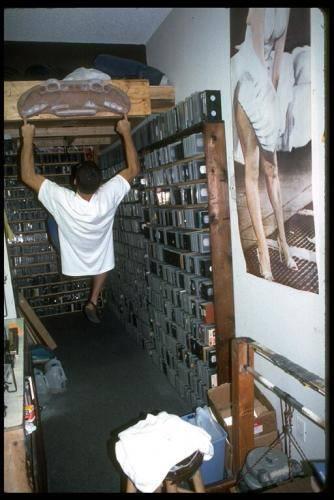
In 1990 I had a fledging business that didn’t allow me to go climbing at all, forcing all of my training around a board in my shop. A serendipitous meeting with a Swiss exchange student, who showed me techniques far in advance of what came with the Metolius Simulator (the only board on the market back then), led to a two month training cycle that transformed me from a 5.10 to 5.12 climber.
life at the @#$%! video shop
In the md-90s one of our friends followed his girlfriend to grad school. A shy lad, he didn’t bother trying to meet climbing partners. Instead he hung Yaniro Board in their apartment and started entering all the national competitions. Out of nowhere, he always finished near the top. This is a guy who’d only redpointed a few 5.12s, did very little actual climbing, and was suddenly beating guys you’d read about in every issue of Climbing. He simply became so strong that he could hang onto basically anything.
elijah demonstrating a move where technique will not help you but hangboard training will
Last year, what’s left of the old Santa Barbara crew, Phil and Elijah, lost their climbing gym, The Shed, a state-of-the art training facility. They bought a Beastmaker, a Moon Board, and hung them in a garage. Turns out a gym full of equipment was mainly keeping their focus from where it should have been all along. Both had the best climbing season of their lives.
phil shows stuff you can do in your mid-40s if you hangboard train
Another of our crew, Micah, used a hangboard because he had ankle reconstruction and couldn’t walk. Before he could even go on a proper hike he ended up redpointing the hardest route of his life.
micah shows stuff you can do when you can't walk if you hangboard train
There are plenty of stories like this. Check out the Anderson brothers, Sonnie Trotter, or the guys over at Beastmaker. As Ben Moon once said, “technique is no substitute for power.”
There are many ways to train effectively for climbing. Almost all of them have some amount of merit that vary in effectiveness due to the individual. Like I state in the article, if you don’t know how to climb there are better ways to spend your time. But when all is said and done, the ability to hang onto holds and not let go is always going to be the single most effective way to raise your level.
Variables
The routine I wrote for DPM is just one option that has worked very well for me. As a multi-sport athlete I’m always in and out of climbing shape. This is the best plan I’ve found for getting back into shape quick, without spending much time (I work a lot). Following the links in this post will give you other ideas. All of them are good. Training should always have an individual element to it. Find what works for you.
The lock-off hangs are very stressful. Proceed carefully. They are a suggested protocol. If you aren’t strong enough and need to alter them your training will not suffer. Do them when you’re ready.
Training is only as effective as your ability to recover. The article's schedule is a suggestion. Tony Yaniro once wrote an article stating that he never decided if he was going to train until he warmed up. If he felt strong he trained. If he didn’t he rested. This can be tricky to gauge but climbing is a tricky, subtle, sport where you put an excessive amount of stress on very small muscles and connective tissues. Listen, astutely, to your body. Hangboard training is generally safer than most forms of training because movement is controlled. Still, it’s easy to get hurt training for climbing no matter what you do. Remember Stevie Haston’s first three rules and live by them.
haston showing stuff you can do in your mid-50s if you hangboard train
Diet
The article presents a few tricks I use to lose weight. I dig a little more into the thought and history behind them next week. For now, drink water. A lot of water. It both keeps your connective tissues strong and helps you lose weight (note the scribbling on stevie's board). And nothing, not even a hangboard, can improve your strength to weight ratio as much as shedding some pounds.
pic at top, tommy caldwell. want to climb massive virtually holdless granite slabs thought to be impossible? hangboard train.
Jumat, 31 Agustus 2012
Drop In
"I'm tired of being left behind. So I'm just going to go do it."
This needs no commentary. Do what you love. Thanks to Aaron for sending it.
Kamis, 30 Agustus 2012
Video of “To Beast Or Not To Beast”
Video streaming by Ustream
Here’s the follow up to last week’s post about our Body Beast program. Denis and I go over the questions I received and answer even more. If you’re not sure what Beast is, whether it’s the right program for you, or how to work it into your existing training plan you’ll want to check it out. We had over 700 viewers and got to all of their questions so we’re betting there’s a good chance you’re covered.
Sabtu, 25 Agustus 2012
Fall Is Coming
Days are getting shorter, leaves are starting to turn, temps are waning; all meaning good climbing conditions are on the where-the-hell-did-summer-go? horizon. As usual, I’ve been tooling around the high country on my bike and am weak as a kitten. With an ambitious birthday challenge on the docket, it’s time for a little training Psyche.
This video shows Canadian climbing Sean McColl doing a workout. It’s rad. I tried a version of this yesterday and could not finish the climbing portion. All subsequent exercises had to be abridged. For reference, I tried doing three 45-move problems that I’d climbed in a single session in the spring, in 4-12 move segments, and could not finish. Pathetic, sure, but basically something I deal with on a yearly basis as a seasonal multi-sport weekend warrior.
That this workout is too hard for me off-the-couch is not surprising. McColl is very strong. As I mimic it my routes will never be as hard as his. I will, however, be able to do most of the exercises and complete this training session by the time I’m ready for the challenge. I will train to do this differently, following an article I wrote that will come out in the Sept 1st issue of DPM. More on that later. For now, enjoy the vid.
A funny aside is that McColl’s session somehow caught the ire of some climbing “training experts” over at the Climbing Narc. If you’re into mental masturbation on training it’s probably worth a read as there are some quality perspectives presented. While the main point, that just because someone climbs hard does not mean they know how to train is valid, it’s also rendered ridiculous in that there is no quantitative data in this case to support the statement.
Sean is one of the world’s best on the competition circuit. What he’s doing here is similar to how all of this competitors train. Granted it’s only a workout-—making no mention of his systematic training plan. But it’s in line with every other elite competitor’s training if, perhaps, slightly more realistic for the average human. To dismiss it is akin to saying the Jamaicans know nothing about sprint training, Kenyans distance training, or Laird Hamilton on surf training. Without real world examples and data you simply cannot dismiss a training protocol that is working at the highest level.
Bradley Wiggins’ team now has a case to state Lance Armstrong wasn’t training efficiently because they have a quantitative improvement. But until your training philosophy can provide data for actual progression, you’re no more prescient than Jesus Quintana.
Kamis, 23 Agustus 2012
Is 30 Minutes of Exercise Better Than An Hour?
An article claiming less is more when it comes to weight loss and exercise hit the wires today. And while it’s decent if you read the entire thing it requires some explanation because the title is misleading. The details as to why are mainly left out, which come down to two physiological factors that I’ll go into today.
30 minutes exercise 'better than an hour of training' for weight loss
It’s important to first note that it’s not saying less exercise is better for weight loss for everyone. The title indicates this but the article shows it’s only better for the study’s demographic, which was both over weight and out of shape. So let’s look at why.
1. The first ten minutes of exercise is the key for most of us. This has been known for a long while but it’s been getting a ton of play lately. A recent study showed that 10 minutes of exercise can be better than an hour if it’s constructed correctly.
These 10 min studies highlight the importance of high intensity work and its effect on hormonal changes. While this study did not going into such depth, all exercise burns more calories in the first few minutes than when you settle in, no matter what you do. This means that you get the effect of high intensity training for a few minutes even when you aren’t exercising hard. This is because you burn muscle glycogen when you begin exercising until your body is warmed up. Once warm, your body starts to conserve; using fat stores for low intensity movements and saving glycogen for high intensity outputs.
A strong hormonal response (triggered by glycogen-sucking anaerobic work) is what you want in order to make the quickest adaptations to your body. You always get one at the beginning of a workout but it's harder to induce them once you’re warm and moving easily. However, high-level athletic training reverses this so the most important period becomes the push you make towards the end of the workout when you are tired, which can create an even greater hormonal response provided that you are fit enough to handle the workload. So, while short exercise is better than longer exercise by some measurements, there are also times, especially in conditioned populations, where the end of longer exercise is what matters most.
2. Exercise is only as effective as your ability to recover from it. Hence the cliché that you only get stronger at rest. If you overtax your body more than you can recover from you get worse before you get better. This is more than anything else the key to this study. By choosing a deconditioned population they were ensuring success because over the course of the study those doing more exercise became overtrained and had to recover from that state before they probably saw a lot of weight loss.
What this study doesn’t tell us is that if you lengthened it, at some point, those doing the longer workouts would outpace those doing the shorter ones. The laws of progressive overload mean that continual stress must be placed on the body in order to keep fitness progression moving forward. This is why if you run 5 miles everyday it will have less an effect as you get fitter. 30 minutes isn’t better than 60 for everybody, but it certainly is better for some. But in fitness is a moving target. As you get more fit you require more stress in order to continue to get fitter. This is why P90X is harder and longer than Power 90.
any excuse to post the 'torture test' works for me.
I’ve written on this subject before from many angles, such as how to choose the right exercise program , but important to address it from many sides. We don’t all need to be able to do Insanity in order to look great and call ourselves fit. For some of us Hip Hop Abs would be the better choice. Less can indeed be more. The only constant is that the human body needs exercise to function properly and some is almost always better than none.
Special thanks to Denis over at the Fitness Nerd for inspiring this post.
Selasa, 21 Agustus 2012
A Look Under P90X2’s Hood
Here’s a great article from P3 on their pre-draft camp that doubles as a deep dive into the science behind P90X2. As you probably know, Dr. Marcus Elliott is a major player in X2’s development. Today you get a look at the kind of analysis and logic we used to create the program in P3’s post:
P3 Pre-Draft: A Scientific Approach to Draft Prep and Career Development
As training becomes more scientific analysis and application become more important. A look back at this program’s history outlines the framework of X2’s development:
Power 90 – The goal to get people moving and eating better. This is the crux for most of us, changing our lifestyle.
P90X – Takes it a step further by applying athletic training principles and methods to create a solid base of fitness.
P90X2 – Uses the latest findings in applying exercise science to improve human movement patterns, which not only creates athletes but reduces injury potential and creates a body that will age slower and function at a high level.
Of course with X2 we can’t do individual analysis you see here. But we use this analysis to find commonalities across the broadest demographics in order to create specific workouts. This is where and how it begins, by looking at human potential with open eyes and using a broad scientific template to improve areas that were once thought impossible to fix. It’s fascinating to see this process unfold, from the technical aspects:
To help John get in better positions to create force and become a more efficient and elastic athlete, we prescribed exercise that improved hip mobility (loaded strength movements, aggressive soft tissue, daily stretching programs) and emphasized eccentric adaptation work (lengthening movements, movements that force relaxation prior to muscle contraction). We worked extensively on John’s stimulus response and nervous system to build quickness and agility.
To the more accessible factors:
The 6-foot-4 shooting guard and two-time SEC scoring champion is toting a chiseled 212 pounds and six-percent body fat – down from 10-percent body fat.
Those of you into techie details are going to dig this, but it’s also a reminder of why you should keep working on difficult balance movements or go 100% on your complexes in PAP. All in all, it should help you realize that when you do P90X2 you’re in the rare company of those who use their bodies to make a living. And since we at Beachbody feel that living means a lot more than making money, access to this information becomes invaluable.
Langganan:
Postingan (Atom)