Jumat, 15 Juni 2012

See You At Beachbody Summit!


I’ll be doing two presentations at the Beachbody Summit next week. If you’re around on Thursday, stop by the Core area at either 12 or 5 to catch the act. These two sessions will preemptively answer a lot of questions about our products and, basically, help you become a more efficient coach.

I’ll also be at the usual venues, parties, etc, as well as Certification the two days prior to Summit’s official start. You can catch me anytime for a chat but, given there will be more than 5,000 of you this year, that’s going to be more problematic than in years past. So come by Core on Thursday or, better yet, come early and get P90X Certified and I’ll load you up with information that will take your coaching to a higher level.

Here is some information on my two presentations. Click on the highlights for more:

How to put your customers in the right exercise program.

I can state how much easier this will make your job. With the right program you’ll get results as easily as A, B, C. With the wrong one you can struggle and get frustrated and spend a lot of time looking for answers. Choosing the right program is step 1 in getting the best results.

How to recommend the right supplements for the right program.

Supplementation are a key part of your tool kit for results. They aren’t magic but can seem like it when used correctly. Every supplement has a purpose and understanding what it is and how it fits with a customer’s goals is a key part of finding success. I'll also be going over some of our newer supplements, like E & E and the new line designed for Beast, which can be utilized elsewhere to help maximize your training.

Efficient coaching.

Learning where all of Beachbody’s resources to help you educate and motivate your customers are located and how to use them will not only ensure your customers reach their goals but save you valuable time.

Finally, consider getting certified. The more you know about the science behind the creation of an exercise program, the more effective you'll be at teaching it. This is particularly true for P90X , which is both versatile and complex, and can be utilized and structured various ways based on the needs of the individual client. You’re coming to town anyway, so why not add this to your coaching arsenal?

See you next week!

pic: summit's always rife with photo ops but this pic, from a coach trip in france, is posted for another reason. i'll have both road and mtn bikes in tow and need to train so hit me up if dawn patrol intervals sound fun. i'll go climbing at least once during the week, too, if you want to pack yer boots.

Rabu, 13 Juni 2012

3 Weeks Of Hell


Training sucks,” said my friend/mechanic/bike shop owner/climber/drinkin’ buddy Tyson the other day as I was dreading heading out for my first interval session on the bike this year. “Riding bikes is great,” he continued. “But training is terrible.”

It’s only three weeks,” I countered. “That’s what it always takes to transition to a base of fitness where it’s no longer miserable. But it’s three weeks of hell.

I’ve been putting off writing this blog—perhaps dreading is a better word—because once it’s published I have to do it. And while I’m often so excited about training that I can barely keep from overtraining out of the gate this is not one of those times. I can’t seem to change my mindset and am not sure exactly why. Maybe I’m more psyched on climbing. Maybe exploring trails sounds more fun than repeated intervals. Maybe I’m just old. But for whatever reason I’m looking forward to the Butte race with about as much enthusiasm as a colonoscopy.

But I stated last week that I’d write up an example so here it is. Besides, I’ve been doing it anyway. And while it hasn’t been pretty, and every morning I wake up feeling as though I was in a bar fight even though I’m ramping up intensity very slowly, I will sally forth and record the results for posterity. ‘Cause that’s my job and, to be honest, I love it even when I hate it because in the big picture it’s another experience to reflect on and learn from.

So here ya go; a glimpse at race build-up from 7-weeks out (while concurrently training for climbing). To understand the reasoning you need to read the backstory here:

The 5 Most Important Factors of Race Training

Week 1 (went like this)

Day 1 – Long mtb ride: a little over 3 hrs of saddle time and a few thousand feet of climbing. Felt hard, especially after 2 hrs. Long road ahead. Did easy yoga and a little foam rolling.

Day 2 – 4 X 10 min intervals full-on with 5-7 min rest in between. Did hill repeats on mtb. Felt weak, miserable. Still sucked it up for some NIS stretching and a 20 minute core workout afterward.

Day 3 – 45 min aerobic spin on the fixie and easy yoga. Went climbing all day.

Day 4
– Biking rest. Climbed half a day. Did easy yoga.

Day 5 – Easy 1 hour mtb ride on trails. About 1,000’ of climbing done easily spinning. No hard efforts. Nice ride. Slacked on post-ride stretching.

Day 6 – 2 X 20 minute full-on intervals. 15 min rest in between. Two long hill repeats. Felt horrible and slow but could feel a slight power improvement from previous workout. Abridged stretching session. Easy recovery climbing in the PM. Blew off both foam rolling and planned full body workout session. Dumb but seriously lacking motivation.

Day 7 – 1 hr RUKE (run/hike), no bike. Hard climbing/training session. Asylum Strength. NIS stretching and foam rolling. This is today. Enthusiasm is a bit higher writing it, probably thanks to reading an old Ben Moon training dairy this morning. Remains to be seen how it goes.

Evaluation from week 1. It happened and that’s a start. Need to get much better at restorative stuff: foam rolling/yoga/core/stability work. Hopefully psyche will perk up.

Going forward this is my template. Each week to consist of:

2 hard targeted bike workouts, always some type of intervals. Goal is to slowly increase these to 4 X 15 min and 2 X 30 minute of all out climbing. These workouts are highly stressful and require a lot of recovery so my daily recovery modalities, supplementation, and diet need to improve.

1 long ride. Saddle time is sorely lacking. Bonked after hour 3 on first ride. I need to be able to do 8 hours without a thought because that's probably where Butte really gets started.

2 recovery rides. Hopefully these are nice trail rides. Lots of spinning and work on technique.

Daily mobility work – either foam rolling or yoga, hopefully both. All of my down time (TV, movies, post-ride beer, etc) should be utilized to work on this weakness. Week 1 was not nearly good enough.

Core and stability work – done post climbing workouts, 2 X per week.

Full body training – One Asylum/P90X2-type workout each week to stay sharp. One hard resistance/agility/plyometric workout during the week helps hormonal production stay high provided recovery is going okay, so this is evaluated on the fly.

Climbing – 3 sessions per week, 2 of them hard. Either outside or in the Coop. Currently climbing outside a fair amount but might move towards hangboard training as bike volume gets high because it takes less total energy output—plus is better training than climbing anyway.

2 weeks away from the race I’ll do a big test, then taper towards race day. The general pattern is 3 weeks of hell followed by a shift in mindset and inspired training. But we’re not machines and things always go a little different, and that’s where all this training stuff gets interesting. I’ll report back after Butte with the results.

Senin, 11 Juni 2012

The Vegan Champion


Congratulations to Timothy Bradley for his victory over boxing legend Manny Pacquiao this weekend, making him the undisputed vegan world champion. While there are a number of celebrated endurance vegan athletes, notable vegan power athletes (like Mike Tyson and Carl Lewis) have up-until-now been retired. Power sports have long been a carnivore’s domain but there’s a new sheriff in town and, with him, a modern template for addressing performance nutrition.

“Dude, I swear it’s the most unbelievable feeling ever,” Bradley said, praising the diet he believes would give him a definite advantage in the ring.

“The reason I love it so much is I feel connected to the world. My thoughts are clearer, crisp. I am sharp. Everything is working perfectly. I feel clean. It’s a weird feeling, man, it’s just a weird feeling.”


Bradley was already a champion but moving up in weight and beating Pacquiao will make him a household name. He isn’t a full-time vegan but that shouldn’t discourage his testament to nutrition because he gets strict when he’s training for a fight, which is where most vegan detractors stake the foundations of their rationale; at the pinnacle of performance. In fact training is exactly where our diet should be tested because what works for the highest-levels of performance is the template we want to use as a base. In the below video he talks about where he gets protein, stating “I don’t really take that much protein,” busting a popular notion of what it takes to be ripped. In the great HBO 24/7 (top video) series he talks about having stores of excess energy, so much that he doesn’t need much sleep even though he’s training 5 or 6 hours per day.

bradley talking about getting protein as a vegan

The main knock on veganism and power sports has always been that you need animal proteins for absolute strength. And while it might be true that the amino acid profiles of meat make this easier to get the proper amino acid ratios the science isn't valid because you can do it without meat and dairy. All that’s been lacking for the public has been a real life role model.

If you’ve followed Beahbody’s diet plans you know we tend to begin with high protein (or low carbs) and graduate towards much less protein/more carbs as you get fitter. This is more as a personal training tool than anything else (though not totally as restricting carbs on an exercise program teaches your body to metabolize fat as fuel more efficiently) because most people eat too many bad carbs and once you learn the relationship with carbs and energy in your diet how to eat becomes much easier. The fact is that your body does not utilize protein very efficiently and beyond a certain amount you’re not utilizing it as protein anyway. It’s vital, and you absolutely need it all day long, but healthy vegans eat mainly whole foods and the beauty of nature is that in their natural state most foods have a solid balance of proteins, fats, and carbs. The more your diet is based on whole foods the less you need to worry about macronutrients because nature will do that for you. A whole food vegan would likely have little need for our basic plans, which is why you currently only find a vegan option to the high-end nutrition plans like P90X2.

The science-based detractors of veganism are losing steam all the time. In an article on Bradley’s diet the Philippine Daily Inquirer interviewed some professionals trying to poke holes in his plan. Nutrition coach Jeaneth Aro stated:

“A well-planned vegan diet can provide all the protein requirements of an athlete in much the same way as a regular diet. However, the major consideration for the vegan athlete is the availability of energy during high intensity exercise. Plant-based protein sources are also high in fiber. Fiber delays the digestion of food, hence the absorption of nutrients."

And while it sounds intriguing there’s not much logic to it unless Bradley is munching on carrots in between rounds, the only time when delaying the timing of nutrient delivery would be a hindrance. With modern food prepping, such as juicing (or vegan Shakeology), arguments like this hold virtually no meaning. Certainly there are nutritional considerations you must address when you’re vegan, especially if you eat a lot of packaged and convenience foods that are stripped of whole food nutrition. But that’s not as much a condemnation of veganism as it is about the Standard American Diet (SAD).

Granted, Bradley didn’t exactly mop the floor with Pacquiao. The result is one of the most disputed in boxing history and most observers seem to think Pacquiao won. But all that means is that they'll fight again, which is more focus, scientific scrutiny, and popularity for vegan eating. So all I have to say about the rematch is bring it on.

if you don’t watch to watch the entire series, the vegan clip is at 6:35 here in part 3

Jumat, 08 Juni 2012

Kids These Days


I know I’m supposed to continue on with Santa Barbara’s climbing history but have been too busy so I’m dusting off an old video of Chris Sharma doing what, at the time (2001), was the hardest route in the world. It’s in the news because today Adam Ondra got a camera crew together and tried to flash it, which is simply ridiculous.

He didn’t, so at least there is something in climbing he can’t do, but this thing just seemed so far out there when Chis did it that even the attempt is almost impossible to fathom. He did manage to flash the first pitch of the route, which had never been done, falling on the final crux. All I have to say about this is “Hey, kid, get off my lawn.”

here's a video of the attempt.

Kamis, 07 Juni 2012

The 5 Most Important Factors Of Race Training


I get a lot of questions from people using our programs who want to transition to training for a race or other athletic event. And although this is my absolute forte it’s still the trickiest part of my job. Not only do individuals vary greatly but there’s no perfect formula, even if you’re a professional with a full-time coach. Throw in jobs, families and other stress tests facing the average weekend warrior and training for an event becomes a crapshoot. This is the reason I’m always tinkering with something new. However, there are 5 factors that you should always assess before you do anything else.

In 7 weeks I’ve got a 100-mile mountain bike race billed “the most difficult in the country”. Last week I received the race bible and now I know why. It’s not the 20,000’ of climbing—-no picnic on any bike—-but things like “4 miles of loose sandy climbing” that have me worried. That and the fact that I’ve barely had time to train. If work allowed for serious saddle time things would be simpler but that seems unlikely. I’m also focused on other sporting goals (climbing), which is another obstacle facing the multi-sport weekend warrior. With these caveats in mind, here’s how I figure out what to do.

1 Start with a goal

You should always begin designing your training plans around a goal and then work backwards. While my true objectives are in the fall (like always), this race is so hard that if I treat is like just another training day I could get injured. So, for the purpose of this training cycle, The Butte 100 is my ultimate goal.

Which means: A 7-week training cycle – 5 week build-up to a hard test two weeks out, then a graduating taper to race day

2 Assess injuries

A recent bike fit moved cleats back on one foot, which happened to be my injured leg, meaning I may have been exacerbating the injury. It also showed my leg length discrepancy was back. This I knew because my mobility training hasn’t been consistent and it’s been the pattern. While both issues cite sloppiness on my part at least I’m not injured right now, so maybe I’m lucky that I haven’t been training harder.

Which means: Back to the daily foam rolling and hip stability training, along with visits to the physio.

3 Assess free time

As stated not a lot. I can probably eek out 10-12 training hours per week that must be shared between three sports: riding, climbing, running.

Which means: 7 hours a week saddle time but willing to increase this for one long ride per week up until week 5.

4 Assess fitness base

My general training keeps my base very fit, which I go into great detail about in this post. Though time in the saddle is lacking I’m reasonably strong and feel like I’m turning a bigger gear than normal during the early season. I don’t have a lot of weight to lose or need to gain any general fitness. I just need to integrate my training to sports specific movements. This is a huge advantage.

Which means: My training time can focus on specificity and my indoor workouts can be for maintenance only. This is a big time saver and the justification for a solid off-season training program like P90X2.

5 Assess the goal

20,000’ of climbing, much of it on loose sand, means that to survive I’m going to need some excess pedaling power. Other than that the course doesn’t look particular technical or challenging, at least not in a way I need to specifically train for.

Which means: Training should be fairly straightforward, focused on hill climb intervals. Ouch.

With these 5 factors assessed I’ve greatly simplified the process and am now ready to create a training schedule. I’ll post the results next week. Now posted here.

pics: training distilled to more of one (hard riding) less of the other (taqueria post bike prom riding)

Selasa, 05 Juni 2012

Training Short For Going Long


One of the biggest challenges a weekend warrior faces is how to prepare for ultra endurance events when you don’t have time for long training days. Last year I experimented with this by training for Duathlon Worlds until Sept, a 1-hour race, and then targeting 3 ultra challenges in November. I primarily used P90X2, Insanity: The Asylum, and sports specific training that rarely exceeded 1.5 hrs a day. To help you create your own training program, here's a recap on how it went.


To analyze is going require some reading (click on the highlights). I posted a lot of training schedules last year so you could see what exactly I’m doing. Of course your personal plan will be different but it’s always easier if you have a reference of volume and intensity to work from.


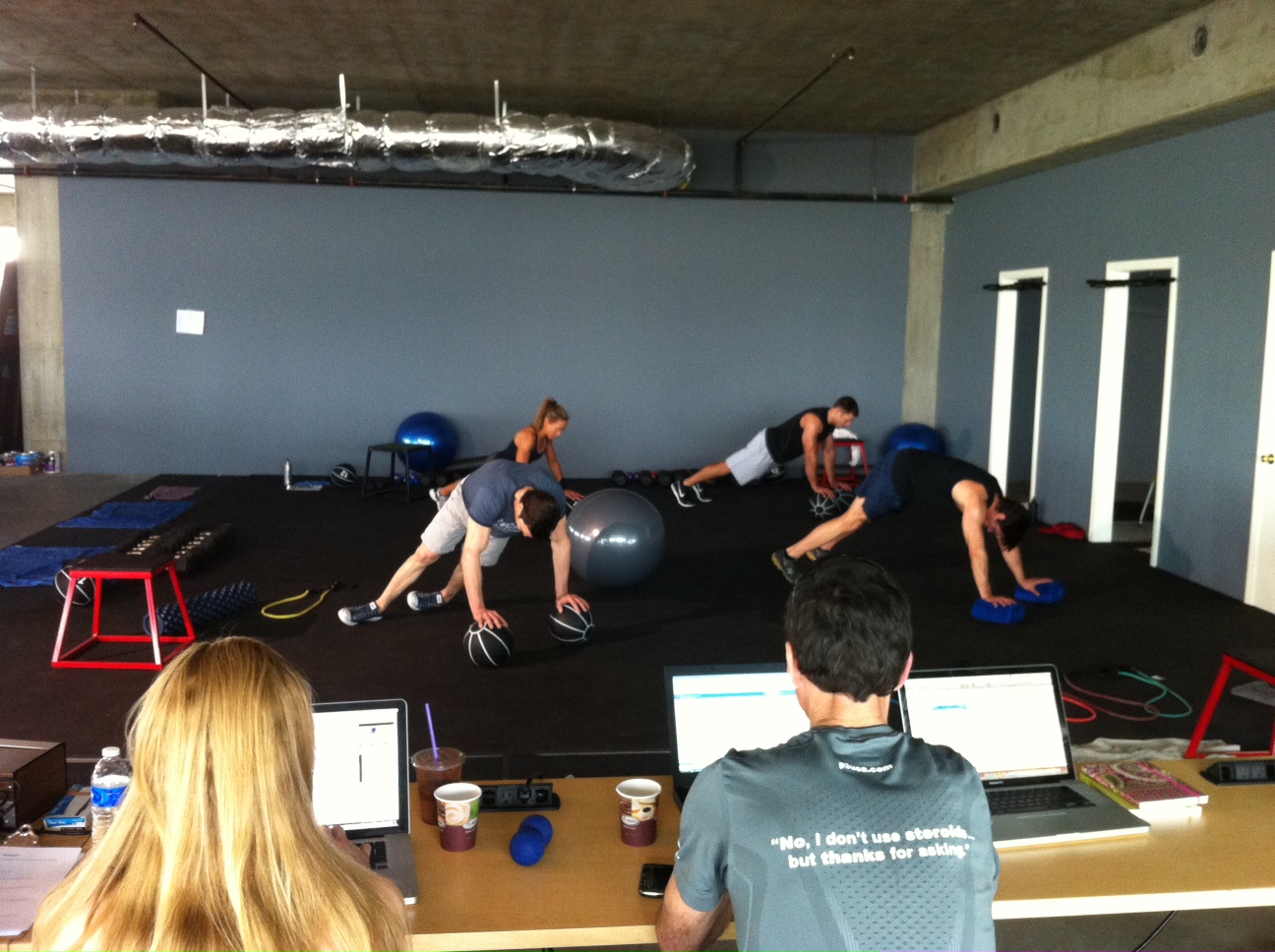
As usual, the year began with a broad stroke training plan in December. With no goals until April, the off-season was spent with a periodizational approach focused on weaknesses. I used a lot of what was to become P90X2 during this time (above is a shot of X2 rehearsals, which went under the working title of mc2), with minimal sports specific training.


Training became targeted with more sports specific work, along with Insanity: The Asylum, for the first peak, Nats in April. Despite the worst spring weather in history, it went well and World’s was officially on. Here’s what I wrote about it:

While a lot of my sports specific fitness is nowhere near its peak my general conditioning is as good as it’s been in my life. I’ve got no acute injuries (other than some scrapes from falling off my mountain bike), my chronic pains are all at bay, and my strength base is very well rounded.

A long “recovery” period allowed me to train more outside and build-up sports specific strength for the next phase of training that would specifically focus on the world’s race. I managed a few long-ish days during this time (6-8 hours) and they went pretty well, a testament to how much having a solid fitness foundation matters. Here's some of what I said at the time. Click on it for a more in depth explanation.

Finally, sports all require specific neuro-muscular patterns (often called engrams) that, while somewhat retained, need to be refined if you plan on continual improvement. Again, these are gained by doing the actual sport. Also, if you’re training is sound you’ve gained fitness (strength, endurance, mobility) which must be taught how to perform. Play time, through specific adaptations of your training gains, will help you get stronger while you aren’t doing any actual training.


Training then became very targeted. After a block of PAP I focused solely on race-specific goals. Chronicled in a long post here (including a daily sched), you can see that training was short, intense, and targeted for an event that I expected to take about 1 hour. An injury derailed my World’s goal (though at least I managed to finish in a reasonable placing), and then it was time for break number two.

After this I became focused on November’s ultra goals: all challenges that would take between 12 and 20 hours of effort. Since one month isn’t long enough to stress and adapt effectively I had to rely on my fitness base to see me through these challenges. All training was specifically focused on other factors that can be changed quickly, such as building up skin needed in sensitive areas and getting used to eating and hydration protocols of endurance racing.


Though an early test (big climbing day) was grim a month later the results were surprisingly positive. Three big events in a month is a lot, even if you’ve trained specifically for them. As I said at the outset:

Now I’m about to test a train short/go long theory on something that is always advised against even for those who train long: three big days in a month (technically closer to 3 weeks). Let’s see what an hour of daily training can do for you when pushed into survival mode.

And while I’m certain I could have been better (faster--though we finished 3rd in a 24-hr race and beat the prior year's winning time) with more focused training my body handled these with relative ease, especially the recovery aspect. Even though the final event, the birthday challenge, wasn’t as hard as planned I was very well rested after it-—birthday challenges that have me digging deep (like this one or this one) often take months to recover from.

In conclusion, if you build a strong base and are smart about your specific training you can definitely compete in ultra events without having a lot of free time to train. Certainly longer sessions increase your ability to go fast. However, the risk of too much free time is overtraining, which is exceedingly common with amateur athletes and that can sink your results faster than being undertrained. This means that, for most of us, having “too little” time to train is probably preferable and, if done smart, will actually increase your odds of success. Finally, there is simply no doubt that P90X2 and Insanity: The Asylum are effective training programs for outdoor athletes. In fact, you’d be hard pressed to find anything better.


Here is a recap of last year’s training, by numbers. It should help any outdoor athlete better understand how to work the balance between indoor and sports specific training.

And, ‘cause we all like looking at pictures, here’s a photo recap.

Sabtu, 02 Juni 2012

“Age Doesn’t Mean Shit”...


...is a somewhat famous quote by track legend Johnny Gray after he won some race (Pam Am Games I recall—maybe age affecting my memory) in his 40s. And while father time will catch up to all of us eventually it’s been my mantra both before and after he’d said it. In fact, I’d say it’s an unspoken mantra for Beachbody since our goal as trainers is to offset aging through diet and exercise, which is more effective than even anti-aging medicine if you want to live an active life for as long as you’re here.

With that I present today’s Psyche vid of 52 year old college professor Bill Ramsey climbing an 8c (5.14b). This is a grade climbed by only a fraction of climbing’s elite. And while it sounds like he gave to route over 400 attempts most people still wouldn’t be able to do this if they were paid to climb full time. It’s an incredible athletic achievement, especially for old dude, and even more so considering how powerful the climb is since we lose fast twitch muscle fiber as we age.

Ramsey’s training is legendary. According to Mike Doyle’s blog:

At some point I will try to get footage of one of his training days. 6am wakeup, stumble to the coffee maker, go into his garage for some deadhangs to warmup, do a little training there, then off to the climbing gym for 3-4 hours then to the treadwall for another 2-3 hours before hitting weights to finish it off. I can’t even fathom it but clearly it works for him.

Who says you have to reduce training volume with age? I am inspired, though I’ll still never attempt one route 400 times because, well, I’d probably lose my mind, my wife, and most of my friends. That said I still find this exceptionally cool.